María Luján Donaire
María Luján Donaire is Chief Creative Officer at Ogilvy South Latin and co-founder of Círculo de Creativas Argentina, a community established to support and promote female talent within creative departments.
After completing her bachelor’s degree in Advertising and Public Relations at Universidad Católica Argentina, she began her career as a copywriter. Over the past 20 years, she has contributed to projects in Argentina and around the world, working with leading brands including Coca-Cola, Volkswagen, Chevrolet, Citroën, DS, Volvo, Unilever (Hellmann’s and Knorr), Mondelēz (Milka, Clight and Tang), Clorox Latin America, Kimberly-Clark, Santander, Philips, SC Johnson, HBO Max and Reckitt.
Many of her creative works have been recognised at renowned international festivals such as Cannes Lions, The One Show, El Sol, the Cresta Awards, PHNX and Ojo de Iberoamérica. In 2019, she was named by Ojo de Iberoamérica as one of the most awarded women in Ibero-America. In 2022, she led the team that positioned Hoy by Havas Buenos Aires as the leading Argentine agency in Latin America, according to the Ojo de Iberoamérica rankings.
She has also served as a juror at numerous prestigious festivals, including Cannes Lions 2023, The One Show 2023, the New York Festival 2023 and the Clio Awards 2024.
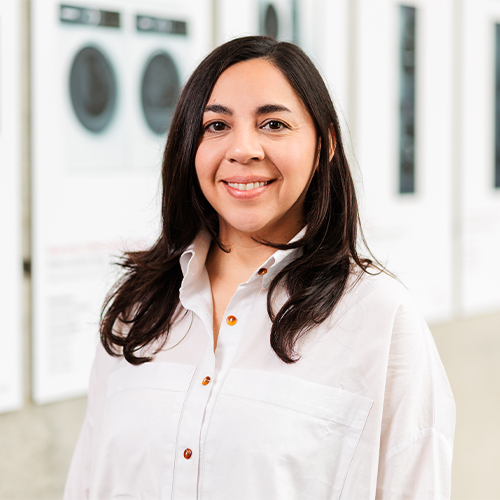
Red Dot in an interview with María Luján Donaire
Is progressive global connectivity having any effect on the brand development process? And how important is a “global” design language?
It’s true that the world is closely connected, but I believe that cultural nuances and imprints give each part of the world its own design identity. It’s impossible to define design without taking the environment into account: the specific needs of a place, the colour palettes that are typical for a specific culture and hereditary style. These things are more important than any short-lived trend.
Have you noticed any specific trends in brand development?
I think the most notable trend to emerge in recent times is that visual language is gaining ground over verbal language. Screens have changed the way we communicate – and our perception of the world has adapted to their codes. Aesthetic standards have evolved alongside the new social culture, and now the use of AI is triggering a new shift.
You co-founded Círculo de Creatividad Argentina. What are its goals, and why is this such an important commitment for you?
Our goal is to close the gender gap in the advertising industry by making female talent visible in creative departments and empowering female creatives. Traditionally, the creative departments in advertising agencies have been a predominantly male domain. Although we are seeing more diversity today, the majority of individuals in leadership positions are still men. This has to change. Communication cannot be conceived or represented with a gender bias. The UN aims to achieve gender equality in the media and the advertising industry by 2030. This commitment is extremely important to me because I believe a person in my position has to embrace the responsibility to contribute to change, and I want to be one of the women who paves the way for new generations.
Diversity is another important issue these days. Why is it so important in the creative industry in particular?
We can become so much more creative and engage with our target audiences far more effectively if we have more diverse teams sitting around the table. Diversity helps us to create more honest campaigns and, most importantly, to dismantle the negative stereotypes that advertising has helped to establish in our culture over the years. We have the ability to influence so many people and create a new culture. That’s an enormous responsibility.
How would you rate the overall quality of the Red Dot submissions? Were you surprised by the variety you encountered at the jury session?
It was a great experience, and I was particularly surprised by the breadth of work from so many different countries. This diversity encourages you to move away from an evaluation based on your own standards to a broader view that also takes the cultural context of each of the works into account. The jury was likewise very diverse, and what I found interesting was the fact that consensus on what constitutes an outstanding work transcends national borders, which is exactly what good design is all about.
How important would you say international design competitions like Red Dot are? Are awards just good for publicity, or does the creative team also benefit?
As an advertising creative, I think it’s great to have so many renowned international design competitions. I believe the industry owes a debt of recognition to the work of designers who simplify and add beauty to our lives. Design is all around us, from the universally understood street signs to the chair I’m sitting on, yet we often take the incredible work behind it for granted. Designers deserve appreciation for their work, and what happens around the Red Dot is truly remarkable.
Last question: is there any brand you would love to design for?
There are many. I love brands that make bold decisions and seek out innovation. In terms of matching design and communication, the two brands that come to mind right now are IKEA and Harvey Nichols.