Prof. Philipp Teufel
Professor Philipp Teufel studied visual communication and scenography at the HfG Gmünd University of Applied Sciences in Schwäbisch Gmünd. From 1985 to 1995, he was a partner at the conceptdesign agency in Frankfurt. Until 2007, Teufel was a partner at the nowakteufelknyrim design studio and from 2008 to 2017 he was managing director of the malsyteufel studio. As artistic consultant for scenography, he supported the Humboldt Forum at Berlin Palace from 2010 to 2015.
Philipp Teufel has been teaching and researching exhibition and retail design at Düsseldorf University of Applied Sciences for 30 years and is currently a member of the Federal Ministry of Finance’s Art Advisory Board. He has also been the Artistic Director of the Garden Museum in Lennestadt since 2020 and recently curated and presented the Japanese Happiness exhibition together with the Identity Foundation. At the moment, he is developing the concept for a new type of science centre.
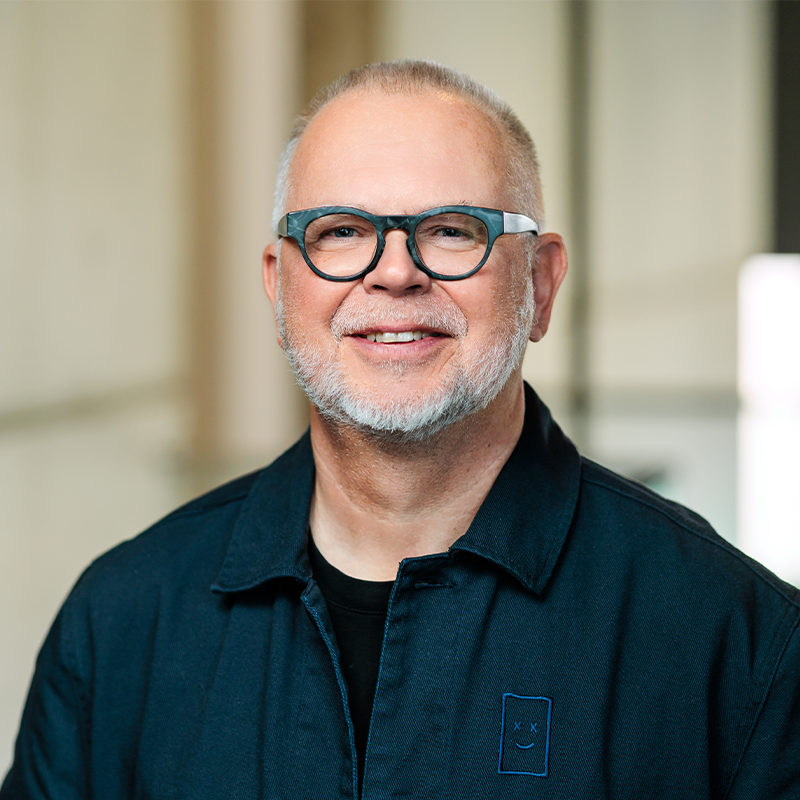
Red Dot in an interview with Prof. Philipp Teufel
You have a career that combines design, architecture, art, media and research: is interior design your favourite creative field?
I first encountered interior design back in the second semester of my degree programme. After that, I spent another two semesters studying the basics of exhibition design. Following an internship with Professor Ludwig Thürmer in Berlin, who was teaching exhibition design at the UDK at the time, I realised that this was the design specialisation that interested and fascinated me the most. After I graduated, the German Film Museum in Frankfurt gave me the opportunity to design my own exhibitions. I went on to implement projects for other museums on Frankfurt’s “museum mile” – the German Architecture Museum, the Jewish Museum, the Historical Museum, the Museum of Prehistory and Early History, the Museum of Modern Art and the Judengasse Museum. Suddenly, I found myself at the heart of the interior design scene and was honoured to be working with so many famous curators, architects, artists and media designers on all kinds of projects and content.
What do you still love about this design genre after so many years?
The vast range of topics and content, as well as the challenge of turning an exhibition space and the exhibits into a visitor journey. I’ve worked on a wide range of projects over the years, and it remains a very enriching experience. Designing exhibitions is comparable to directing theatre or film. It’s always exciting to create new exhibition scripts and productions.
To what extent have visitor-interaction options and multimedia technology changed the approach to exhibition design?
The approach to exhibition design hasn’t been fundamentally changed by multimedia technology. However, concept-development and design processes have become more complex and multi-layered, and the visual forms of expression have become more diverse and immersive.
What kind of an exhibition “inspires” an expert like you?
It has to surprise me, hit me – and have a lasting effect. Let me give you two examples: one of my favourite exhibition venues is the Feuerle Collection in Berlin. It’s located in a former bunker, and the exhibition design is the work of John Pawson, a.k.a. the “Godfather of Cool”. His staging of the Asian art collection there is more than impressive. The exhibition concept is coherent from start to finish, making this venue a must for anyone who wants to experience a truly special exhibition in Berlin. But you have to be willing to abide by the Feuerle Collection’s rules. That’s all I’m going to say! The other exhibition that really appeals to me is “Nature. And us?” at the Stapferhaus in Lenzburg, Switzerland. The Stapferhaus was architecturally engineered with exhibitions in mind, and anything is possible there – from daylight-flooded rooms to black boxes. My esteemed colleagues at Kossmanndejong in Amsterdam have already designed and implemented a number of stunning exhibitions in this building. “Nature. And us?” was a barefoot exhibition, and two hours after visiting I could still feel the exhibition on the soles of my feet.
Exhibition and retail design are usually seen as one and the same. Is this true, or are there significant differences?
I don’t see any significant differences in the design concepts, but there are differences in the design objectives. The proximity of retail design to exhibition design is unmistakable: both present exhibits or products on shelves and in showcases or displays. Retail product assortments are the equivalent of exhibition collections, both vying for the attention of visitors or customers as they wander through the presentation or aisles, viewing items that are displayed in a classified, staged or composed scenography. Museums and shops can both be understood in terms of the way they exhibit their “collections”. However, although they employ the same presentation and staging concepts, they operate according to different business models. Since the 1990s, the reciprocal influences between market-based retail establishments and museums as places containing original, authentic and unique cultural artefacts have been expressed in the concept of the flagship store.
You describe these similarities in detail in your book Holistic Retail Design. Has the digital transformation changed retail design?
Consumers haven’t changed in terms of their fundamental behaviour, and shopping still follows the three retail archetypes of market, magazine and museum. Customers are “consumers and citizens”, “enlightened consumers” or “lifestyle tourists” who bring their own values and motives to the shopping experience. Retailers and retail designers have to select the right mix of archetypes for their business model and implement it creatively.
For a number of years now you have been Artistic Director of the Garden Museum in Lennestadt – what do you enjoy most about this role?
Having designed numerous exhibitions and museums, I wanted to change my perspective and explore the genre from a curatorial standpoint. So I came up with the idea of a museum – and met a young entrepreneur who loved the idea and was brave enough to finance the project. This experience has changed my professional role because I have been increasingly working as curator – also for other exhibitions.
To what extent has design education changed in the recent past, and which aspects will become more important in the future?
Two central changes are the increasing role of AI in the creative process and the emergence of new production options made possible by a range of digital tools. Students have to learn to use these technologies confidently and to apply them in their concepts and designs. At the same time, they need to be made aware of the risks and challenges involved. One thing that will never change and a guiding principle that has always permeated my teaching is: design is attitude.
Do you advise your students to be generalists or to specialise?
As an educator, I always take a close look at my students’ personalities and aptitudes. Some go on to become great generalists, while others know even as students that they are destined to be perfect specialists.
Can you tell us something else about your current “Japanese Happiness” exhibition?
Numerous trips to Japan and multiple joint exhibition projects with local Japanese institutions have fuelled my fascination for the country’s aesthetics and culture. I wanted to share this enthusiasm with others – so I teamed up with a colleague to create the “Japanese Happiness” project – again in a curatorial role. In our project, however, “Japanese Happiness” doesn’t reference the happiness of the Japanese. It references all cultures. It is true, though, that Japanese aesthetics have been more focused on the reconciliation of humans and nature in the cycle of life than Western aesthetic theory, which tends to focus on indifferent pleasure.
How did you approach the project?
We asked ourselves the questions: how do you exhibit happiness, what is happiness, and where can it be found? These are the same questions that New York-based designer Stefan Sagmeister has been considering in some depth. “The Happy Show” is an exhibition that showcases the findings from his own happiness research. It has been shown at various museums around the world with great success. Copenhagen even has its own happiness museum, and at the end of last year, the “Hello Happiness” exhibition was shown at the German Hygiene Museum in Dresden. So the theme of happiness is obviously very popular in the museum and exhibition scene.
The “Japanese Happiness” exhibition is both an experimental and sensory design exhibition. It strives to illuminate the connections between happiness and Japanese aesthetics using selected everyday items, design pieces and works of art. Japan-based typographer Helmut Schmid once called it “the quiet beauty of things Japanese” in his exhibition “nippon no nippon”. This aesthetic experience can of course exist in all cultures, but we believe that Japanese aesthetics are more attentive and devoted to quietude than Western aesthetics. From a Japanese studies perspective, the picture of Japan painted here is certainly very incomplete and one-dimensional. But perhaps the friction between cultures and disciplines will lead to new insights?
This exhibition also thrives on different perspectives ...
That’s correct. Pieces were selected from 20 invited co-authors in the fields of art, design, philosophy, cookery, Japanese studies, music, fiction, fashion, photography, typography and exhibitions, all of whom either have a personal connection to Japan or live there. We aim to give the public the opportunity to share the happiness that these objects embody in our eyes through the selected exhibits and installations. We want to convey and communicate this happiness in both sensory and insightful presentations.
And last but not least, the design concept and implementation are the work of students taking master’s degree courses in exhibition design at the Düsseldorf University of Applied Sciences and the Estonian Academy of Arts.