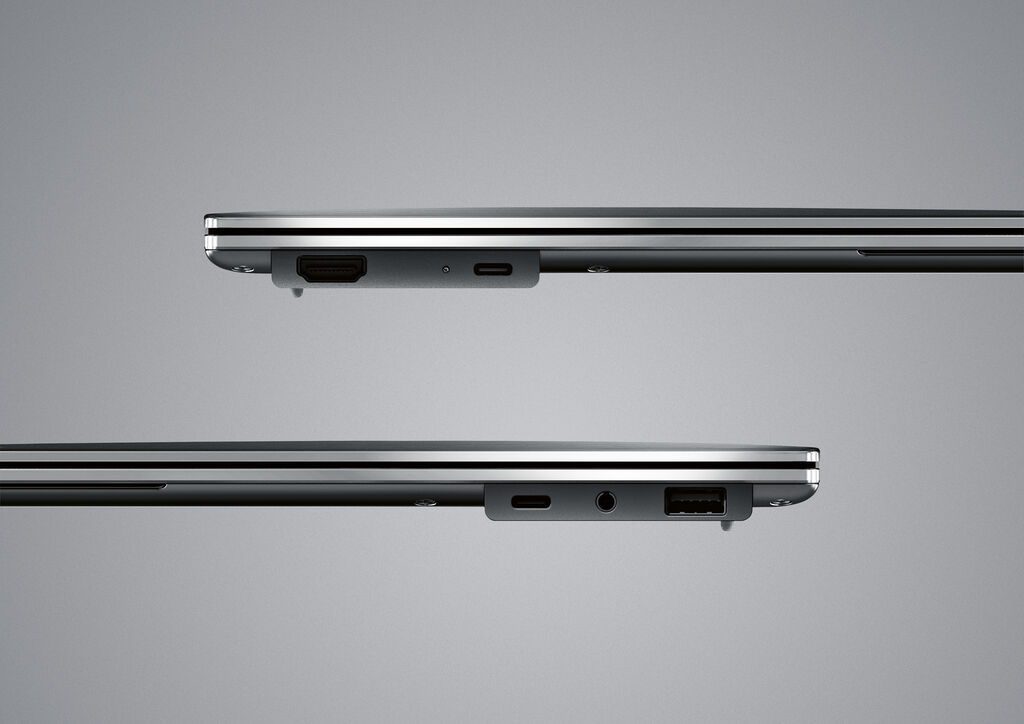

Ever thinner, more mobile devices continue to be the holy grail of the notebook industry. Ultra-thin profiles must, however, coexist with high-performance thermal systems and a versatile port offering. And today, notebooks must, of course, also include integrated AI PC technologies. Designers thus face an ever greater challenge. To address it, big Chinese tech enterprise Lenovo rethought the form factor of its new ThinkPad X9 series from scratch. Its central structural element is an innovative new “engine hub” on the system’s underside, which allowed Lenovo to maintain the desired slim profile. Like a black bar, it runs along the device, contrasting with the silver-grey chassis of the laptop, and contains AI components as well as the thermal system, the fans, the motherboard, the AI chip set and input components. This ensures optimal airflow and cooling at the same time as enabling a particularly efficient and easy-to-service internal layout. The “engine hub” is also ergonomically well integrated into the structure, doubling as the system’s rear foot and providing the required gentle forward tilt of the keyboard. There is sufficient space on the side of the “hub” for larger ports, while the rest of the silhouette is ultra-thin. The series – available with displays of 14" and 15.3" – also features a subtly revised version of the ThinkPad keyboard with its typically rounded keycaps, and the iconic TrackPoint was dispensed with in favour of a large touchpad with pleasant haptics. The notepad also has a special tactile quality thanks to the grooved texture on the underside, which improves the carrying experience and helps people with physical disabilities. The robust aluminium chassis is initially formed from 50 per cent recycled material in a sustainable manufacturing process, then CNC milled to save time and reduce waste. The jury was full of praise for the notebook. “One might have thought the end of the laptop design evolution was in sight, but the ThinkPad X9 proves that there is more progress to be made. It offers a highly functional, extremely neat new approach that is also visually and haptically well thought-out down to the smallest detail.”