Adriana Monk
Adriana Monk studied product design at the ArtCenter College of Design in La Tour-de-Peilz, Switzerland, and earned her degree in Pasadena, California, beginning her career at the BMW Group Designworks USA. Within just a few years, she had established herself as one of the automotive industry’s leading interior designers for luxury brands, such as Rolls-Royce, Jaguar and Land Rover, before pursuing her passion for yachts. In 2008, she founded Monk Design in Switzerland. The studio’s focus is on performance yacht design, both exterior and interior, as well as on exclusive detailing and graphic design. She primarily designs custom sailing and motor yachts for private clients. Custom corporate jets are now also part of her Design in Motion portfolio. Adriana Monk is constantly innovating and producing creative solutions that reflect her balanced sense of proportion and aesthetics. Her work has won several international awards, including the World Superyacht Award, Red Dot Award, iF Design Award and Eurobike Award. She has lectured at the Royal College of Art in London and at the International University of Monaco. For many years, she was also a jury member at competitions such as the Boat International Design & Innovation Awards. Adriana Monk was recently invited to be a member of the prestigious Concorso d’Eleganza Villa d’Este jury as a classic car assessor. Passione Engadina and the Goodwood Festival of Speed are on the calendar for this year.
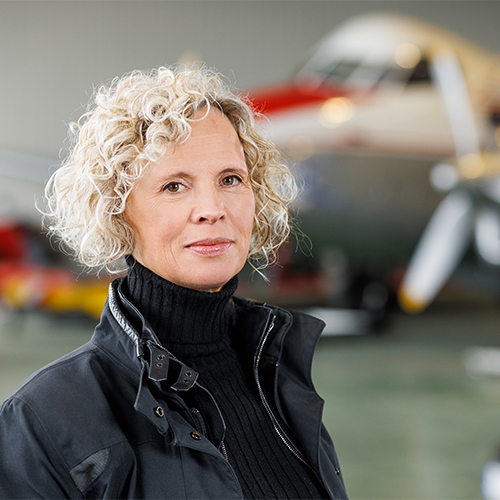
Red Dot in an interview with Adriana Monk
You specialise in transportation design. How did that come about? Have you always had a passion for vehicles?
Design is in my DNA. Growing up with two industrial designers as parents, I was immersed in a world where form meets function from a very early age. The first project on my journey into transportation design involved the development of a concept for the interior of the Range Rover. This experience gave me the opportunity to push the boundaries between luxury and function, and the project’s success launched me into a decade of automotive design.
What has been the driving factor behind your work all these years?
I think it’s been the opportunity to apply advanced technologies to concept interiors and transform creative visions into tangible experiences. I’m fascinated by the challenge of optimising small spaces to make them appear bigger because every detail counts – from material choices to the spatial concept and the emotions it evokes. “Design in motion” is my guiding philosophy. It reflects my passion for designs that aren’t just aesthetic, but also come alive through movement.
This ethos has shaped my work for brands such as Rolls-Royce, Lincoln, Jaguar, Land Rover and Wally, which has involved translating the brand values into form, emotion and materiality. Expanding into yacht building felt like a natural evolution because these vessels are mobile sculptures that balance performance and elegance, function and poetry. The aspiration to create a seamless flow from interior to exterior spaces ultimately persuaded me to turn my attention to the design of the exterior proportions. The combination of curiosity, creativity and movement continues to inspire and motivate me in my work to this day.
But you’ve never lost your love of automotive design, have you?
My love for automobiles took root in Italy, where I grew up surrounded by iconic cars such as the Alfa Romeo Giulia and the Fiat 600. I still cherish that heritage today, and I drive my mother’s classic 1969 Fiat 500.
Another of your areas of specialisation is designing high-end performance yachts. What specific challenges does that entail?
Designing high-performance yachts presents unique and exciting challenges. What motivates me is the duality of balancing the demands of racing with the comforts of refined living in a limited space. Safety comes first in every decision, but the real challenge is adaptability: a racing yacht that can be effortlessly transformed into a cruising experience has to be both functional and beautiful.
I always strive to create minimalist designs that conceal complexity behind elegant simplicity. This means that every element, from furniture to storage spaces and circulation areas, must work seamlessly and intuitively, even in hectic conditions.
How important is materiality in your designs? Do you already have certain surfaces in mind during the design process?
Materiality is fundamental to my design approach. Innovative structural materials often encourage me to explore new forms. There is beauty and honesty in celebrating materials for what they are. That’s why I often prefer to leave the structural material visible rather than disguising it. Certain surfaces naturally lend themselves to specific materials, and tactile, textured surfaces enhance the emotional experience.
How do you approach the selection process?
I work with a carefully curated palette of modern materials and colours. Ultimately, I have to respect the client’s vision in order to create something that is both personal and timeless. Yacht interiors are inherently complex, so I aim for visual clarity and calm through simplicity, allowing forms, finishes and light to speak quietly but with purpose.
Lighting design is another important factor in your work, isn’t it?
Harnessing natural light and careful lighting planning are essential. Smart yet elegant lighting solutions can define a space and enhance its functionality by emphasising the architecture and creating a warm, inviting atmosphere.
“The details are not the details. They make the design.” Does this quote by Charles Eames also apply to your designs?
Charles Eames perfectly captured my personal design philosophy with that quote. When I work, especially on minimalist interiors, the details often define the essence of the design. When the overall canvas is clean and restrained, it’s the small elements that are decisive: the stitching, the material transitions, the precision of the joints. All these things interact to elevate the overall experience. Balance is essential. The details don’t serve to distract, but to unify, creating coherence and refinement. I choose carefully which details to emphasise in order to ensure that the design remains harmonious, with each component contributing to the overall look rather than competing for attention. In spaces where simplicity is key, these carefully considered, impeccably executed details make the strongest impact with subtlety.
Budgets are obviously no longer a major issue in your projects. Does that give you the freedom to be more pioneering in your designs?
It’s a common misconception that budgets aren’t an issue in luxury projects. Design flourishes when resources are strategically allocated to innovative materials and cutting-edge technologies. This allows the creative team to push boundaries and achieve truly pioneering designs that are as unique as they are personal.
What radical changes do you see in the automotive industry? Has e-technology changed much? Or doesn’t it play a major role in design?
E-technology has fundamentally transformed automotive design. It has changed the cars’ exterior appearances and liberated their interior spaces. Flat floors (without a central transmission tunnel) and spacious cabins are redefining how we experience mobility.
I’m also intrigued by the integration challenge. Our smartphones will always outpace our vehicles in terms of updates and personalisation – so creating seamless transitions between these ecosystems is becoming the key to customer loyalty. Large flat screens are now everywhere, which obviously makes fingerprints an issue, but the real opportunity lies in user-interface optimisation. The shift to autonomous mobility will be even more radical. We’ve stopped designing cockpits and begun designing living spaces for a generation that may never need a driving licence. This is an exciting paradigm shift that challenges all previous assumptions about automotive design.
You’ve been on the Red Dot jury for many years. Is the experience still exciting and inspiring?
Being a Red Dot Award juror is an honour, and it continues to be one of the dates on my professional calendar that I most look forward to. Every year, I look at the designs and innovations through a new lens, which is enriching and keeps the experience fresh.
The Red Dot team does a marvellous job with the competition organisation from start to finish, and it deserves tremendous credit for the meticulous preparation, attention to detail and flawless execution. Their commitment to excellence is a benchmark that deserves to be emulated across the industry.
What I value most are the intense and in-depth discussions with the other jury members. This is design dialogue in its purest form: rigorous, passionate and collaborative.
And last but not least: as a man who designs vehicles for water, road and air, how do you personally prefer to travel?
In order of preference, I’d start with water because I’m a passionate sailor and enjoy taking part in regattas – from superyachts to classics. I’m lucky enough to crew aboard Tuiga, a yacht built by William Fife in 1909. It’s an example of truly iconic and timeless design, performance and elegance.
On land, I zip around on my Vespa, which is an efficient way to travel and a liberating experience. My 911 is an absolute pleasure to drive and unites equal measures of power and grace – on Alpine passes and coastal roads.
Air travel is obviously a big part of my schedule because I have to visit clients, tour shipyards and attend jury meetings, so I spend far too much time in airports. Yet despite the routine, travelling to different places never fails to inspire me. Nothing is more valuable than one-on-one dialogue.