

Interview with 3st kommunikation
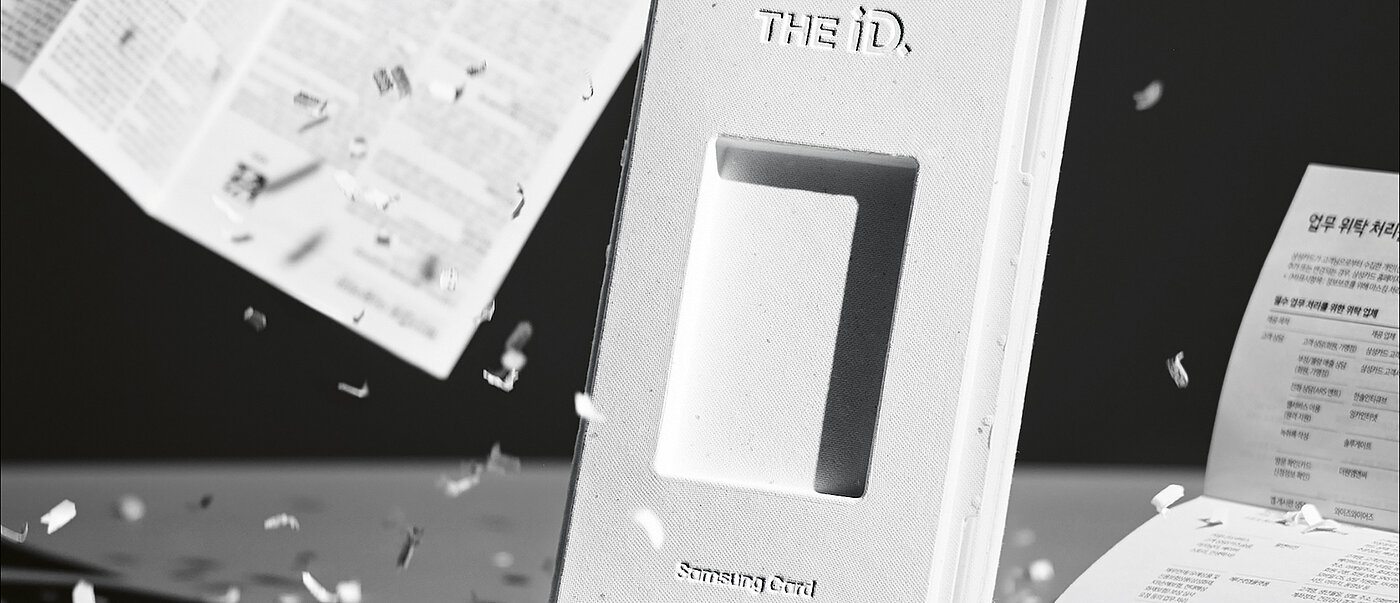
The credo of Samsung Card’s Brand Experience (BX) team is simple: continuously improve the user experience while preserving the values of a brand. When developing the new credit card packaging, the designers also had the group’s ambitious sustainability goals in mind. They succeeded in creating a charming circular solution that allows economy and ecology to go hand in hand: “It’s a small step, but we believe that meaningful change often starts right where we are, with what we already have.”
Red Dot: What sparked the initial idea for developing this sustainable packaging?
The project started with a simple question: Why do we throw so much away? In the credit card industry, printed service guidebooks are indispensable, but they are often discarded after minor updates. Although the switch to digital was already underway at Samsung, not everyone – especially older people – has digital access. That’s why we reused already produced but outdated guidebooks by converting them into environmentally conscious cardboard packaging to give waste a second life. It became a quiet but meaningful gesture of caring, combining sustainability and inclusion through design.
Does this solution also make economic sense?
It is aligned with Samsung Card’s sustainability goals, for waste is minimised and the packaging is made from 100 per cent recycled paper, with no chemical inks, films or adhesives. Although the initial development required some investment, material costs have been significantly reduced in the long term by leveraging existing resources and logistics expenses due to the smaller and lighter format. Overall, it is a compelling model in which sustainability and cost-effectiveness go hand in hand.
What was the biggest challenge in the design process?
The challenge consisted in finding a production partner willing to work with raw, recycled materials. Many factories rejected this idea due to concerns about machine damage and low profitability. Eventually, we found a forward-thinking partner who shared our vision. Over the course of a year, we jointly developed a solution that harmonises sustainability with durability and ensures a high standard of quality. Extensive prototyping and close collaboration were required to achieve structural stability while minimising environmental impact.
The waste paper used naturally does not have a uniform colour. Did the coloured inclusions prove to be an advantage in the end?
Absolutely. The natural variations in colour and texture became a defining design feature that makes each packaging unique. Customers responded positively to the sense of individuality and quality craftsmanship. Instead of concealing imperfections, we embraced them as part of the storytelling, enhancing the authenticity of the recycled materials.
Is paper an ideal material when it comes to sustainable ideas and recycling?
Paper is exceptionally versatile, lightweight and infinitely adaptable. Its inherent recyclability makes it an ideal choice for environmentally conscious design. In our case, it allowed us to develop an adhesive and ink-free concept that still met all functional and structural requirements.

