

Interview with RXM Creative
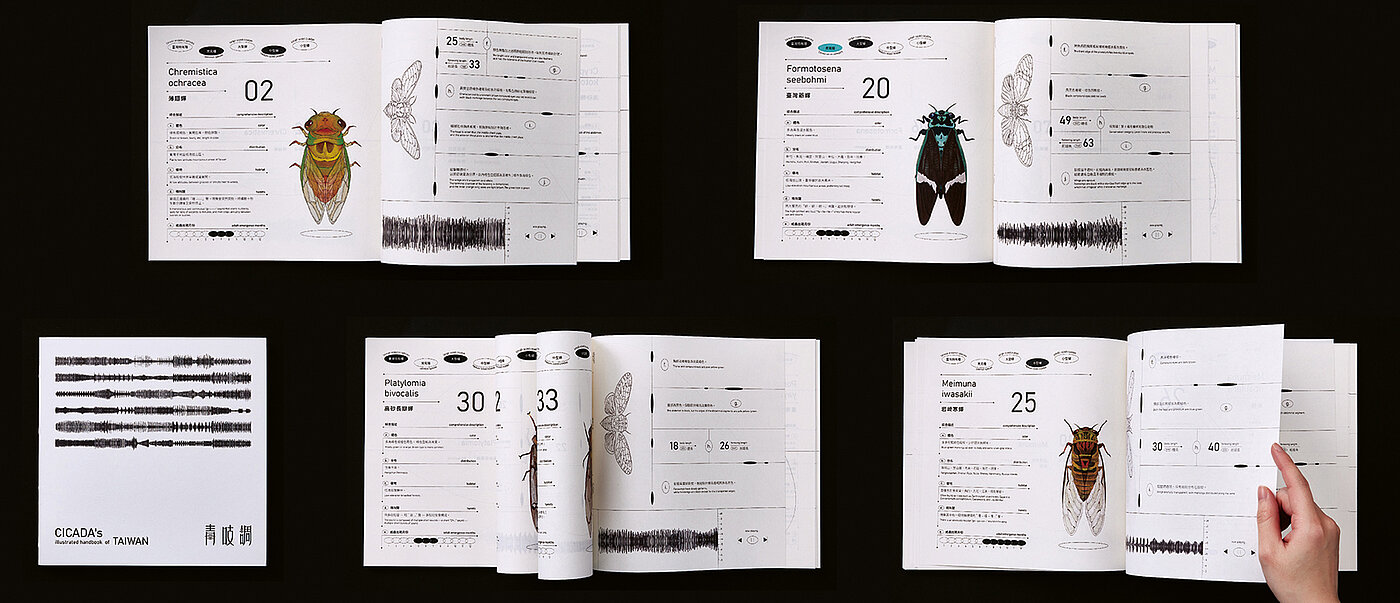
On warm summer nights, you can’t miss it: the chirping of cicadas. Yet what if these characteristic sounds were not only audible, but could also be seen? This question sparked the interest of Ling Tung University students Ruo-Xuan Chen, You-Zhen Lin, Hui-Chieh Lai, Yi-Ching Ho, Yong-Qi Lai and Wan-Chun Liu. During intensive research, the team came across over 60 registered cicada species in Taiwan and meticulously studied their features: “We found that identification from photos was difficult due to their similarities, so we created a realistic illustration for each species.” These illustrations were compiled on cards together with information about the respective species. But mere visualisation was not enough for the students – they wanted to create a holistic experience and therefore also started to explore the possibilities of 3D printing. The path further led to two cicada experts who provided them with sound recordings. “To ultimately combine sound with visuals, we designed a series of soundwave tubes and playback devices. Each cicada call was first converted into a 2D waveform illustration, then developed into a 3D soundwave model and finally printed out as a physical soundwave tube,” the students explain. These tubes can be exchanged on the playback device to discover the different cicada sounds. “Cicada’s Tune” thus combines scientific research, visual communication and product design into a remarkable, interdisciplinary project that not only has outstanding illustrative quality, but also demonstrates the fascinating possibilities of 3D printing. Supervised by Professor Wei-Hsien Lan and realised within just six months, it is an elaborate work by a team of young talents.
Red Dot: What sparked your interest in this topic?
It all started with the loud chirping of cicadas right outside our classroom. We realised that although we hear cicadas every summer, we don’t know much about them. While researching on the internet, we came across their scientific names, including Cryptotympana atrata and Cryptotympana kotoshoensis. We also realised that the data on Taiwanese cicadas is quite scattered. This is what truly sparked our deep dive into the subject. We found that around 60 cicada species have been recorded in Taiwan, 60 per cent of which are endemic to the island. This far exceeded our expectations, as we had previously assumed that there were only around ten species. Surprisingly, we also learned that many of them live at medium to high altitudes and are therefore virtually undiscovered.
What was your goal in creating this work?
We can well envision our work serving as an educational tool for ecological and environmental topics in schools, ecological centres and outdoor exploration activities. At present, most environmental education programmes rely on clicking links and playing online videos. Yet, teachers often encourage their students to put down their phones, leave the computer and spend more time in nature. This is why we created a tangible sound playback device to reproduce the sounds of cicadas. It’s a fresh and engaging way to learn about Taiwan’s cicadas.
Did you already have the opportunity to experiment with 3D printing during your studies?
No, we hadn’t. We were familiar with 3D printing technology but had never used it ourselves. It was an amazing experience – it felt like we were printing ideas directly from our minds. I can definitely recommend that everyone give it a try!
Your work is a combination of communication and product design. Is interdisciplinary design particularly appealing to you?
If we had relied only on our strengths in graphic design, it would have lacked that special something – like a signature dish without its soul-stirring seasoning. We all wanted to experiment with different media and made a final decision after much discussion. As we had no experience in designing electronic devices, this was a big challenge. We had to consider audio-visual features, ease of use, interactivity, portability and external design. Throughout the process, everyone contributed their individual strengths. We had to overcome many hurdles, but in the end all parts of the project were a great source of inspiration.

